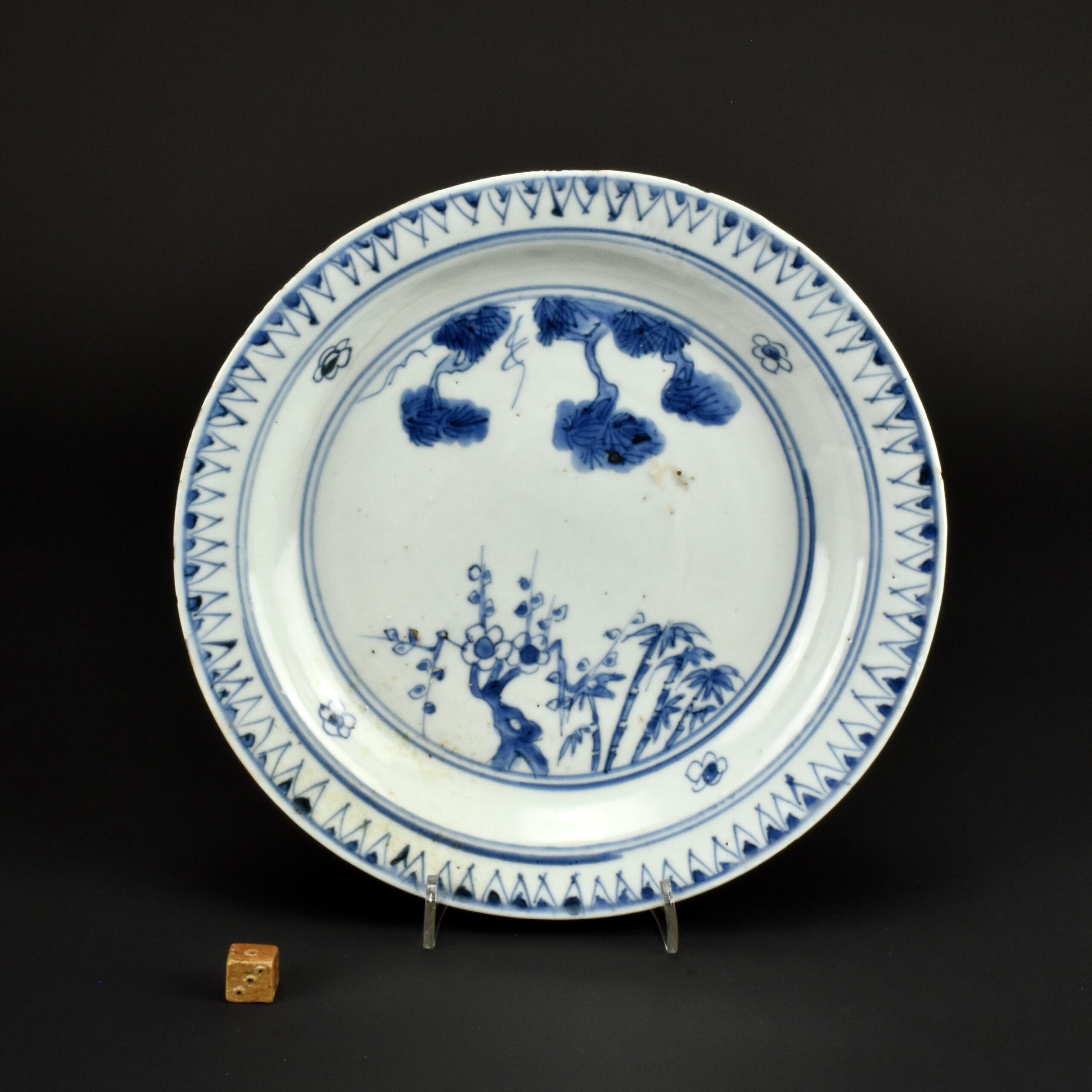
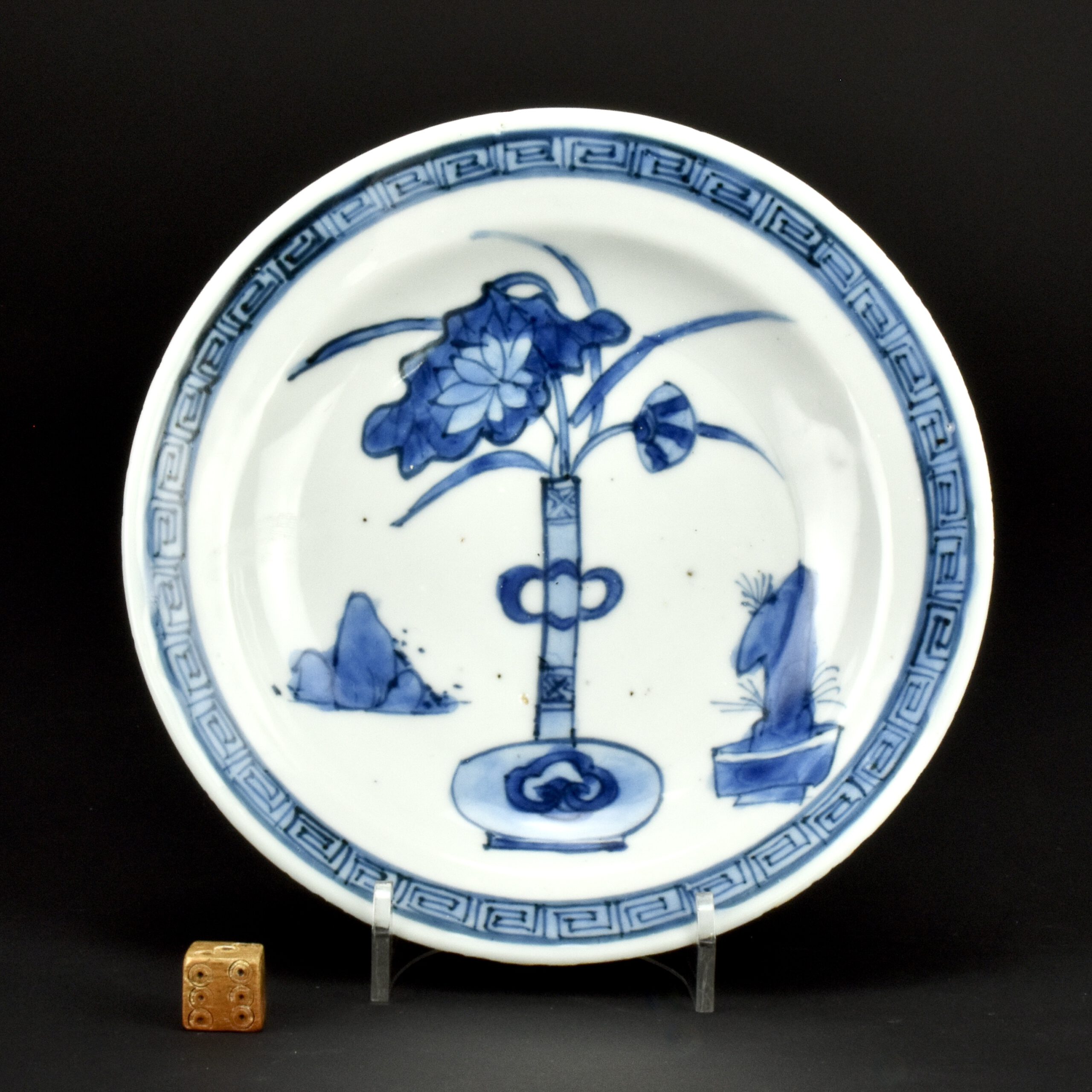
A Ming Ko-sometsuke Porcelain Dish, Tianqi Period 1621-1627
$29.32
$36.36
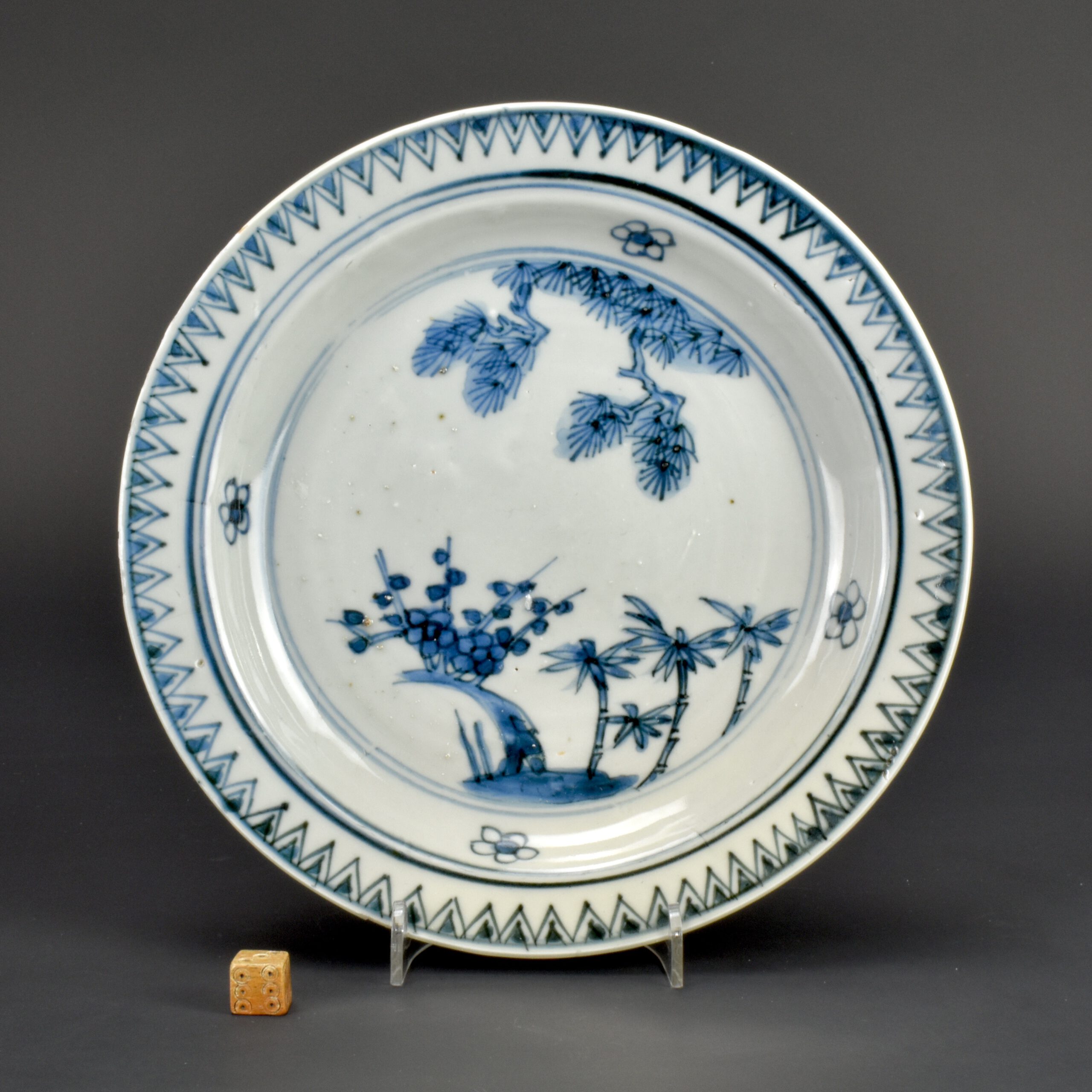
A Ming Ko-sometsuke Porcelain Dish, Tianqi Period 1621-1627, Jingdezhen Kilns. This Chinese blue and white late Ming dish was made for the Japanese tea ceremony. The scene depicted represents a well-known theme, which appears in many different ways on Chinese and Japanese porcelain, that is The Three Friends of Winter. The Three Friends of Winter are represented by Pine, Bamboo and Prunus. These three plants signify perseverance as seen in nature during winter. Pine might be old, gnarled, misshapen by winter winds, yet it still survives, bamboo bends in the wind, throwing off snow and it survives the coldest winters. The plum, prunus family in general, flowers at the very end of the winter, heralding the arrival of spring. In this design, the bamboo is to the lower right, with angular pine entering overhead, and a broken, but still flowering, plum tree is to the lower left. The plum design is reflected in the border, with four facing prunus flowers placed asymmetrically. The border to the everted rim has a continuous sawtooth design. The base, which shows distinctive chatter marks, is painted with two concentric circles. Beyond the footrim are three Ruyi designs based on the Lingzhi (sacred fungus). Ko-Sometsuke is a term used to describe Chinese blue and white porcelain made for Japan. This late Ming porcelain was made from the Wanli period (1573-1620), through the Tianqi period (1621 – 1627) ending in the Chongzhen period (1628-1644), the main period of production being the 1620’2 and 1630’s. This porcelain made in China for Japanese reflected a rise in interest of the Japanese tea ceremony, but it also coincided with the beginning of porcelain production in Japan (from c.1610/20). The porcelain objects produced in China were made especially for the Japanese market, both the shapes and the designs were tailored to Japanese taste, the production process too allowed for Japanese aesthetics to be included in the finished object. It seems firing faults were added, repaired tears in the leather-hard body were too frequent to not, in some cases, be deliberate. These imperfections as well as the fritted Mushikui (insect-nibbled) rims and kiln grit on the footrims all added to the Japanese aesthetic. These imperfections were something to be treasured by the Japanese, they reflect an imperfect world and the aesthetics of Wabi-Sabi. These ‘faults’ was an anathema to the Chinese, but they went along with it to satisfy the needs of their Japanese customers. The shapes created were often expressly made for the Japanese tea ceremony, especially the meal associated with tea drinking, the Kaiseki. Small dishes for serving food at the tea ceremony are the most commonly encountered form. Designs, presumably taken from Japanese drawings sent to China, these are very varied and often extremely imaginative. They often used large amount of the white porcelain contrasting well with the asymmetry of the design, sometime the Chinese couldn’t help themselves but to fill in these gaps with ‘excess’ decoration. Many other forms were made, among them are charcoal burners, water pots, Kōgō (incense box) as well as variously shaped dishes in the form of fish, fruit or familiar country animals. For a Ming blue and white porcelain dish with this design and size see : Trade and Transformation, Jingdezhen Porcelain for Japan, 1620-1645 see ‘References’. See Below For More Photographs and Information.
Japanese And South East Asian